
Japan is a country filled with contrasts. One minute you’re gawking at towering skyscrapers emblazoned with neon signs, and the next minute you’re wandering around Japanese gardens submerged in tranquility and surrounded by bonsai trees.
From the zen to the zany, there’s a dualism in Japan that unfolds in equal measure. You oscillate between these two worlds, often just streets apart, with dizzying effect.
I’ve never been to a country that can separate and stretch itself into so many defined and unique places. Where else will you find a cat island (Aoshima), an art island (Naoshima), a rabbit island (Okunoshima), and a deer island (Miyajima) in one country?
To have even one of these eccentric, thematic islands in one country would be a unique offering, but the abundance of them puts Japan in a league of its own. As a visitor, you never quite know what you will find, and this element of surprise is intoxicating.


Cities within a city
Almost every city I visited wove together pockets of absolute peacefulness and pockets of pure chaos, with no examples better than Osaka and Tokyo.
The world’s largest city, Tokyo, is like a hundred different cities smashed into one. It’s so condensed and busy you could drop whole countries into the same-sized space and it would only be half-filled.


In contrast with the intensity of urban life in Tokyo, is the sacred mountainside town of Koyasan. Here, it’s like stepping back in time, where nothing but ancient temples and cedar trees reside, all seemingly existing to honour the dead at Okunoin Cemetery.
Then there’s the historical old-world city of Kyoto, where Geisha’s are often spotted meandering through the narrow alleyways of Gion.
It’s the place you head to if you’re looking for quintessential Japan: the Golden Temple, the retina burning splendour of Fushimi Inari Taisha, and the seemingly infinite stalks of bamboo at Arashiyama, used as a film location for Crouching Tiger Hidden Dragon.
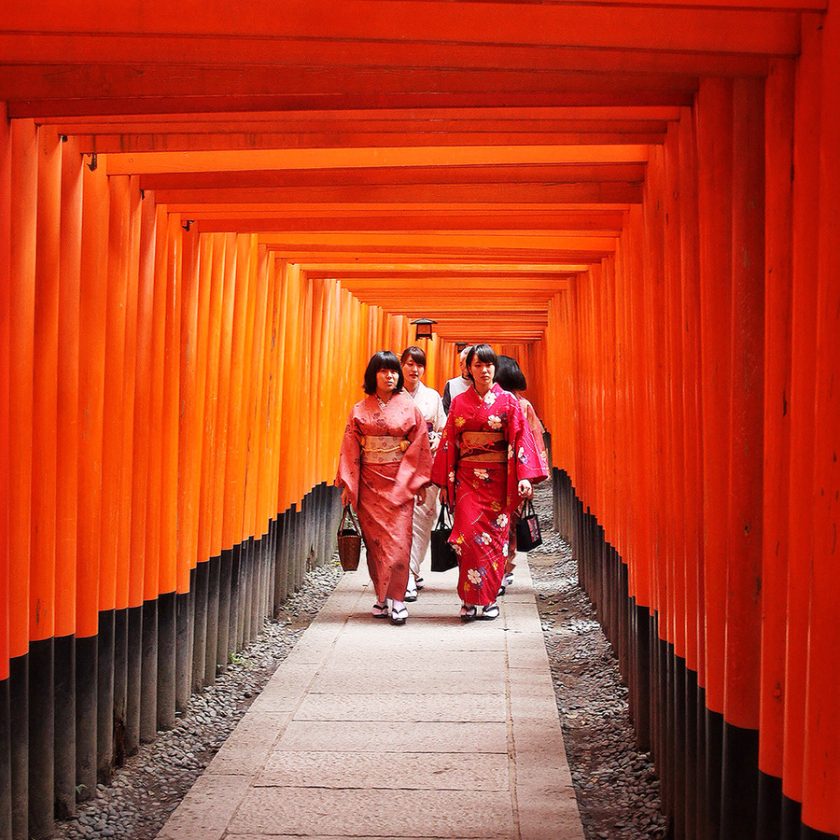
These clear-cut differences can be found not only from city to city, but from street to street and from building to building. You don’t have to search for long to see examples of these contrasts.

The differences between day and nights
There’s usually a big difference between day and night in the big cities too. After daylight, out crawls Japan’s underbelly. A glare of naked bulbs, hundreds of flashing adverts and billboards cast a mesmerising glow across the streets.
In a metropolis like Tokyo, there’s nothing you can’t find. It’s a city made for epicureans, for better or for worse, you can find everything to satisfying the most gluttonous among us. Head to Shinjuku any night of the week and neon chaos ensues. This is also your chance to see Japanese youth culture out in full force.
At first you wonder if everyone is going to a fancy dress party that you haven’t been invited to. Where are they going dressed like that? But then you realise that the streets are the stage, and cosplay dressing is the norm – there’s no occasion needed.
Tokyo is meant for people watching – and I’m a fan of most dress styles – apart from the lolita-esque outfits. I’m not too sure what the deal is there but it’s common enough to find a plethora of clothing shops to supply women wishing to dress like young girls. It’s a far cry away from traditional kimonos and understated fashion you’ll otherwise see. Again, Japan is full of contrasts.
Battle of the bright lights

Dotonbori – Osaka’s famous ‘foodie’ street.
There’s nowhere on earth that quite competes with Japan when it comes to quirky restaurant façades and neon signs.
The lights are so bright, and the battery-powered figurines so big and gaudy it’s impossible to miss them. When the whole point is to attract the attention of passersby, bigger truly is apparently better.

I don’t think we need to guess what this place specialises in!
I’m not sure about you, but this kind of advertising has the adverse effect on me. I undoubtedly question the quality of food in a restaurant if it needs to have a massive mechanical crab gyrating above the door (the pincers really do move to imitate a real crab – it’s rather creepy!).
My theory could be completely wrong though. This is just a hunch. I’m usually drawn to smaller, intimate places which seem to whisper in my ear, ‘mamma’s little kitchen….’
Either way, you won’t be in short supply of good food. With more Michelin-starred restaurants than anywhere else on the planet, Tokyo is the gourmet capital of the world. And don’t worry, good food doesn’t stop for budget conscious travellers. The options are endless all over Japan.

Indulging in Sushi at the world’s largest fish market.
Planning a trip to Japan?
Spending longer in Japan and need inspiration? Read my 2-week itinerary and my Koyasan travel guide.
Accommodation: I always use Booking.com to search for available accommodation when I travel. I recommend spending at least a few nights in a traditional Japanese ryokan.
Activities and tours: Browse and pick from a variety of tours available in Japan via Get Your Guide or Viator.








6 responses
Such a well-written piece, Shing! Japan has just moved higher up the list. x
Thanks Rob! I’m glad Japan has been bumped higher up your list! I hope me, you, and Ki can do something soon! X
You are totally right about Japan and I remember thinking the same think when visiting it. Japan really is full of contrasts and this is what makes it incredibly interesting to my eyes, a very unusual culture for me.
Hi Franca, I’m happy you agree with my observations about Japan! If you’re anything like me, you must be dying to go back as well!
Great post! Japan is one of my dream destinations – everything about it intrigues me!
I hope you make it to Japan Ashley, it really is a dream destination! Fascinating for so many reasons!