
During our road trip in Northern Argentina, one of the places we loved the most was Purmamarca in the province of Jujuy.
In addition to Purmamarca, we also stayed in Salta, Humahuaca, and Cafayate while visiting surrounding attractions. I’ve already written about the spectacular drive from Salta to Cafayate on Route 68, and now I want to share with you my thoughts on the cosy town of Purmamarca.
The drive into town makes an impression with the Seven Colours Hill appearing on the horizon like a mirage or abstract painting. The vivid colours and naturally occurring patterns don’t quite look real and I’m reminded of the beauty of the planet and its never-ending surprises.
From a distance, Purmamarca appears snuggly wrapped in a multi-coloured blanket. And while only being a small place with a population of around 1000 people, its special energy and incredible landscape securely put Purmamarca on the map.

Accommodation in Purmamarca
We stayed in Ecohotel Posta de Purmamarca, and when we arrived we could hardly believe our luck. It looked as pretty as a postcard. Everything about it spoke to my senses.
Made from local materials such an adobe, I loved the way the facade harmoniously blended into the landscape. And best of all were the views overlooking the town’s most famous landmark.
Los Colorados Circuit

After dropping off our things, we laced up our hiking boots and made our way to Los Colorados, a 3km trail that highlights the magnificent Seven Colours Hill Mountain. It’s not a long hike but it packs a punch.
The trail is easy and weaves through sculptural shapes, showing off the region’s rich geology which has carved the landscape. The colours are a result from the accumulation of sea, lake and river sediments in the area for over 600 million years. The tectonic plate movements that took place later gave these sediments their current location in Purmamarca.
If you only have time for one hike in the region, Los Colarados, though short is the one to do. You can choose from two entry points. I started at the entrance next to Hotel Los Colorados and exited by the cemetery. After a little incline at the beginning, most of the trail slopes downwards and offers sweeping views of the spectacular valley. At some points I felt like I was walking on Mars.
The shapes and colours hardly seem real and yet I would never be able to dream up anywhere so spectacular. Copper minerals tint the greens. Limestone and clay soften into yellows and whites. It’s not a painted mountain. It’s chemistry and pressure and uplift made visible.
Purmamarca Main Square and Market

Once you exit the trails of Los Colorados, it’s a short walk to the Main Square. The plaza is the focal point of life where both tourists and locals gather to enjoy the town’s atmosphere. The surrounding market is often home to musicians, food stalls and local artesans selling traditional handicrafts.
When the Spanish arrived in the 16th century, resistance here was fierce. The Calchaquí Wars in the broader region lasted over a century. Communities were displaced, resettled, fragmented. The colonial system reshaped everything – land ownership, labour, religion – but it didn’t erase identity.
In the plaza and further afield, when you see women and men selling handwoven textiles and handicrafts or carrying out high-altitude agricultural tasks and rearing livestock, it symbolises the continuity and strength of the indigenous population who have continued their traditions in the face of colonial powers.
Church of Santa Rosa de Lima
Overlooking the Plaza is a modest colonial church, built in the 17th century with adobe walls and traditional construction. It’s humble and spartan inside, however, look up at the roof which is made from giant cactus wood and noted for its porous appearance.
Until arriving in this region of the world, I never knew that cactus could be a viable building material. It’s not something I’ve ever seen in Europe, but then again, Europe isn’t a place filled with giant cactus.
In these high-altitude Andean regions where conventional timber is scarce, the Indigenous population have been using cactus as a structural material since the pre-Columbian era. Cactus is light but strong, easy to cut and shape, and resistant to rot in dry climates, making it a popular choice for ceilings.
Outside of the church stands an ancient algarrobo tree that still stands at the ripe age of nearly 700 years old. It’s one of Purmamarca’s historical symbols and a nice low-key stop to connect with the deeper timeline of the town. For good fortune, locals will tell you to make a wish under the tree.
Attractions nearby Purmamarca
Tilcara
A bit further north lies Tilcara. It’s a bit busier than Purmamarca, partly due to the more affordable accommodation which makes it popular base for travellers on a budget.
The town is made up of markets, cafés, murals and the main attraction is Pucará de Tilcara, a pre-Columbian fortified settlement, and today it functions primarily as an archaeological site and tourist attraction.
Located on hill, it was once a living, functioning settlement with homes, storage areas, agricultural terraces, ceremonial spaces and defensive walls. Although I liked walking around the site, I was a bit disappointed to read that some of the reconstruction work has not been faithful to the original design.
I found it especially odd that the construction of the main monument took inspiration from a mix of Inca, Mayan and Aztec design. I guess artistic license was prioritised over historical accuracy on this occasion… While it looked good, I would rather have left with a better understanding of what the settlement would have truthfully looked like all those years ago.
Humahuaca & the 14-Coloured Rainbow Mountain

The thing that stood out to me the most about Humahuaca was how authentic it felt. Humahuaca is a quiet town of narrow streets, adobe walls and colourful murals. You’ll find a selection of cafes and restaurants – perfect for a spot of midday coffee or a plate of locro, the hearty Andean stew.
Above the city stands an imposing 9-metre tall figure of an indigenous man. The monument pays homage to the Army of the North and the squads of gauchos and natives who fought in La Guerra Gaucha, a series of conflicts which defended the nation against Spanish royalists. Walk to the top for panorama city of the town and surrounding nature.
The most famous landmark of Humahuacca is the 14-coloured mountain, also known locally as Cerro Hornocal. If you already thought the 7-colourful mountain in Purmamarca was striking, this one will take your breath away.
Despite its close proximity, it still takes around an hour to get there by car from Humahuaca due to the uneven terrain and winding road to the top. Give yourself plenty of time by setting off early if driving from Purmamarca.
The view of Cerro Hornocal is nothing short of spectacular. I’ll never forget the astonishment at standing in front of a zig-zag patterned mountain layered with so many colours! It’s definitely one of the highlights of Northern Argentina and I recommend anyone to visit if they are in the area. Remember to take it slow, you’ll be at an altitude of over 4000-metres which can make walking up-hill more challenging.
Salinas Grandes
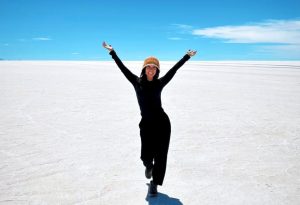
The salt flat of Salinas Grandes is one of the most popular attractions to visit near Purmamarca. A few weeks before arriving in Purmamarca I had already visited Uyuni in Bolivia which is home to the world’s largest salt flat so I decided not to visit Salinas Grandes since I didn’t have a lot of time at my disposal.
However, if you’ve never visited a salt flat I would definitely recommend going to this one. If it’s anything like the one at Uyuni, you’ll feel like you’ve stepped on another planet. It’s incredibly surreal.
Sheets of brilliant white shimmer under the sun; it’s almost blinding. Even if its raining, don’t despair, the surface becomes a mirror after rain. You can either rent a 4×4 and drive out onto the flats or book a full-day tour directly from Purmamarca to Salinas Grande.
Final thoughts

I would recommend anyone to stay in Purmamarca, not only is it beautiful, the unique shapes and colours found in the surrounding nature gives the town a magical atmosphere.
Some people opt to stay in Tilcara, but I found the town a bit too touristy and less relaxing, so if your budget allows I recommend staying in Purmamarca if you’re deciding between these two places. I spent two nights in Purmamarca which is an ideal length to give you enough time to venture out with your car to nearby attractions and squeeze in some nearby hikes.
I also spent two nights further north in Humahuaca, but if you’d prefer to move around less, then 3-nights might be better. Either way, as long as you visit Purmamarca, that’s what counts!