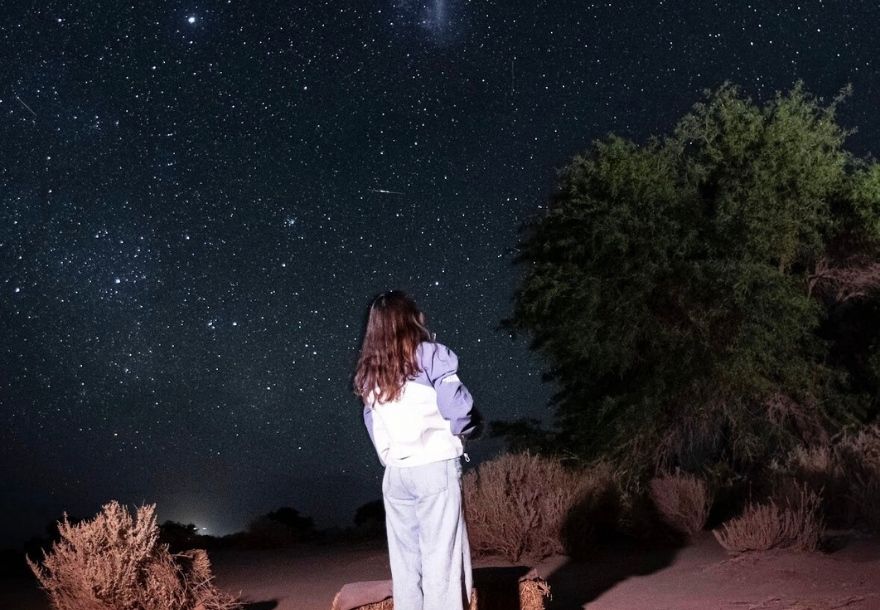
The Atacama desert in northern Chile is one of the best places in the world for stargazing. This is for three main reasons: the high altitude, less light pollution and clear, dry nights.
There are many natural wonders to see and things to do within a short distance from San Pedro which explains the town’s popularity. You can visit salt flats, sand dunes, rust-coloured mountains, and volcanoes rising from a landscape that receives almost no rain.
Perhaps more than any of these things, the most unique activity that you can do in the Atacama Desert is a stargazing tour. Personally, I prefer to do things by myself so I generally opt to avoid tours. However, there are a number of reasons why stargazing in the Atacama Desert with a guide is an essential part of the experience.
All of the photos of the deep-space objects in this blog post were taken on the tour.
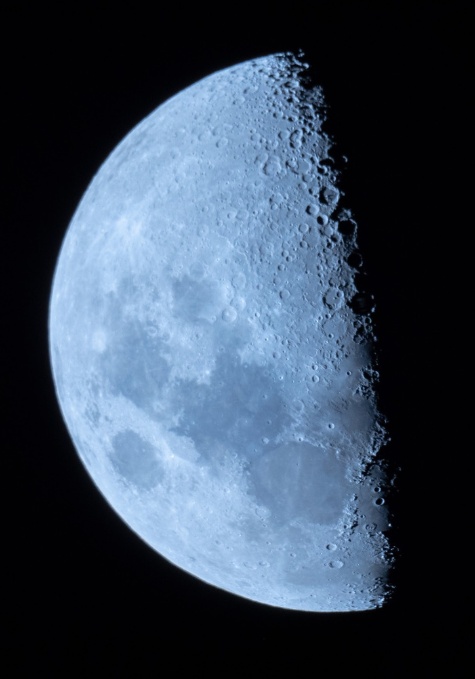
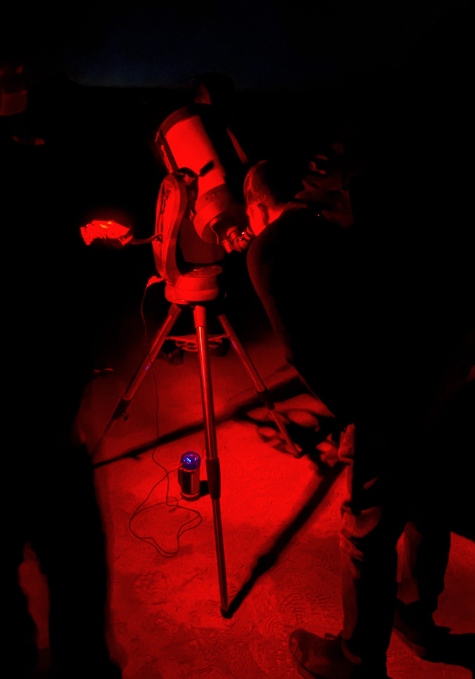
Why should you join a stargazing tour in the Atacama desert?
Stargazing on your own in the Atacama Desert can still be spectacular, but I discovered that joining a guided tour from San Pedro will considerably enrich the experience.
First, the equipment and expertise make a huge difference. Stargazing tours provide powerful telescopes that allow you to see details that are impossible with the naked eye. Through the telescope I viewed the rings of Saturn, nebulae, and distant star clusters within the Milky Way and beyond. Without my guide’s knowledge, many of the most interesting objects would simply look like anonymous points of light. I learnt so much, but I should also add that my understanding of astronomy was practically nothing.
Second, tours take you to the best observing locations. Guides know where to find the darkest skies away from town lights and dust, often driving visitors out into remote areas of the desert where the atmosphere is exceptionally clear. They also adjust the viewing depending on the season and the positions of planets and constellations, ensuring you see the most interesting celestial objects that night.
Finally, most tours include a photographer who will take photos of you to immortalise the moment. While mobile phones usually do the job on most occasions, night photography is a different kettle of fish. Furthermore, snacks and hot drinks were offered to us while we stood under the desert sky.
Arrival at our camp
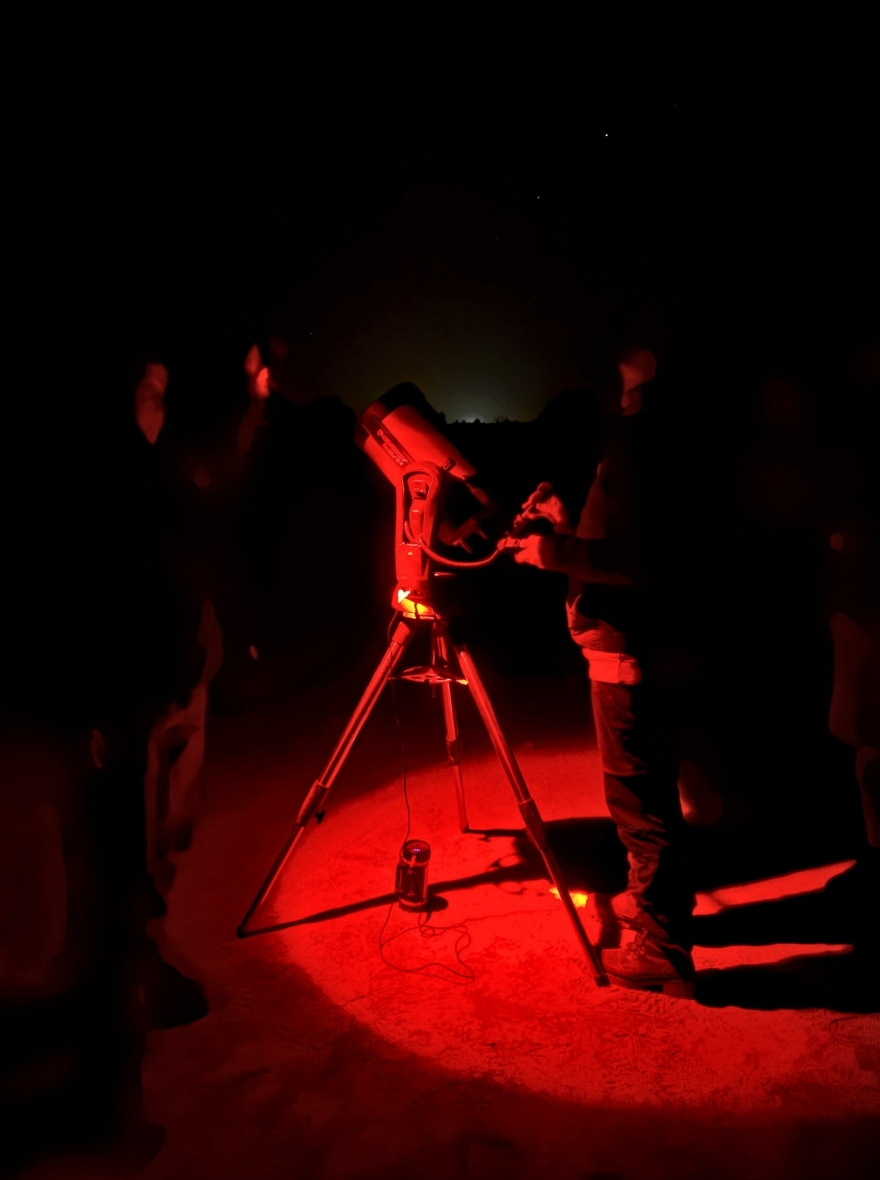
After we arrived at the camp, our guide got to business straight away by setting up the equipment that would allow us to understand what we were seeing in much more detail.
I had never seen so many stars in my life, and being able to witness such a sky with my naked eye already felt like a huge privilege. We were standing under the Milky Way – specifically the Orion Arm. With a powerful laser pen in hand, our guide pointed out two galaxies that can only be seen in the southern hemisphere.
A few fun and interesting facts that I discovered
As mentioned, I knew very little about astronomy so every bit of information blew by mind. I felt a child again, being in a world I knew nothing about and everything felt new and exciting.
The whole experience really put into perspective how little I know beyond planet Earth. The universe is far larger, older, and more mysterious than anything visible during the day. I used to think of Earth of this huge mass of land and water, but in the context of the Milky Way, it’s just a mere grain of sand.
- Looking at stars is like looking back in time. Stars are so far away that their light takes years, hundreds of years, or even thousands of years to reach Earth. That means when you see a star, you are actually seeing it as it was in the past.
- Some stars have planets like ours. Many stars in the Milky Way have their own planets orbiting them. These planets are called Exoplanet, and astronomers have already discovered thousands of them.
- Star are usually always bigger than planets. Maybe everyone already knows this – like I said, I knew nothing. I could name the planets in our solar system but that was about it. Despite knowing that the sun was a star, I incorrectly thought the sun was an exception, believing that stars were relatively small because that’s what I see when I look up at the sky. Silly, silly me!
- The Milky Way is our “cosmic neighbourhood”. The Milky Way is a giant galaxy containing about 100–400 billion stars. Our Sun is just one of them. If the galaxy were the size of a country, our solar system would be like a tiny house somewhere inside it.
- Reddish stars are older. If you see reddish-coloured stars this means it’s older. Our guide pointed out a reddish star called Betelgeuse (commonly pronounced Beetlejuice) which is nearing the end of its life. When it bursts it will create a super nova.
- Shooting stars are a misnomer. They are actually asteroids which are stars that have burst and it’s the bits and pieces that you see.
Through the lens of the telescope
I remember as a kid, we had a little telescope that honestly was more like a toy – a pretend telescope. Other than that, I had never looked through the lens of a telescope, never mind a professional one with capabilities to see things millions of lightyears away. Telescopes are to astronomy what microscopes are to biology. You can see things that you would never be able to see with the naked eye.
Here are a few deep-space objects that we saw through the telescope. I have woven in some information provided by our guide as well as a bit more research.
The Tarantula Nebula
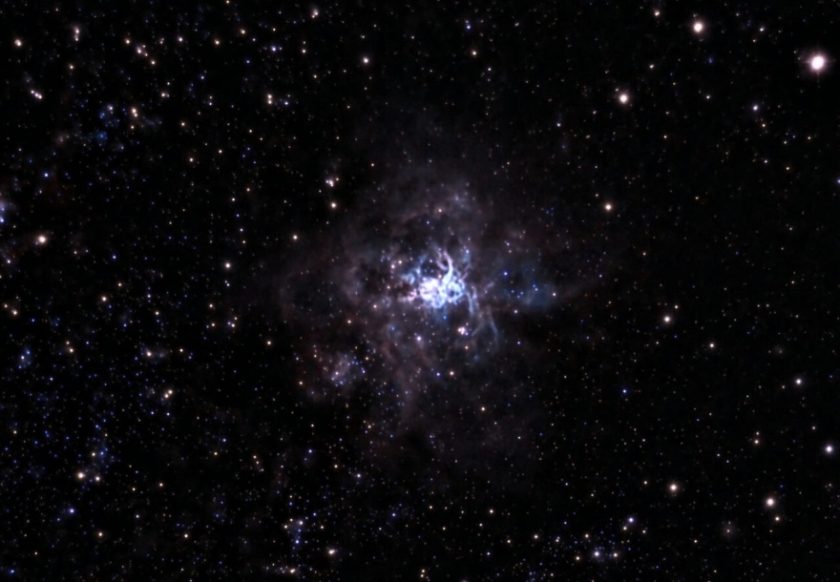
The Tarantula Nebula is a huge cloud of glowing gas and dust where new stars are being born. It is located about 160,000 light-years away inside a nearby galaxy called the Large Magellanic Cloud, which orbits our own Milky Way. At the centre of the nebula is a very bright cluster of young stars known as R136. These stars are extremely hot and powerful, and their energy makes the surrounding gas glow and twist into the bright, web-like shapes.
Visually speaking, I found it the most beautiful deep-space object to look at under the telescope with its intricate, icy blue structure. It dawned on me that the sky has many colours that we cannot see at night. We can only see in black and grey and shadows but through the lens of a telescope you can really see how colourful is the sky!
Astronomers find the Tarantula Nebula fascinating because it is one of the most active star-forming regions known. Many massive stars are forming there at the same time, lighting up the nebula and shaping the clouds around them.
The Andromeda Galaxy
The Andromeda Galaxy is the closest large galaxy to our own Milky Way, located about 2.5 million light-years from Earth. It’s an enormous spiral galaxy containing around a trillion stars, much larger than the Milky Way itself.
As we observed it, our guide said that the “light reaching your eyes began its journey millions of years ago”, meaning that the exact version of the Andromeda that I was seeing (complete with a halo made from star dust) existed long before humans appeared on Earth! And this applied to most of the things we observed through the telescope. I’m still trying to process this information. It’s too monumental for my tiny brain to compute.
Orion Nebula
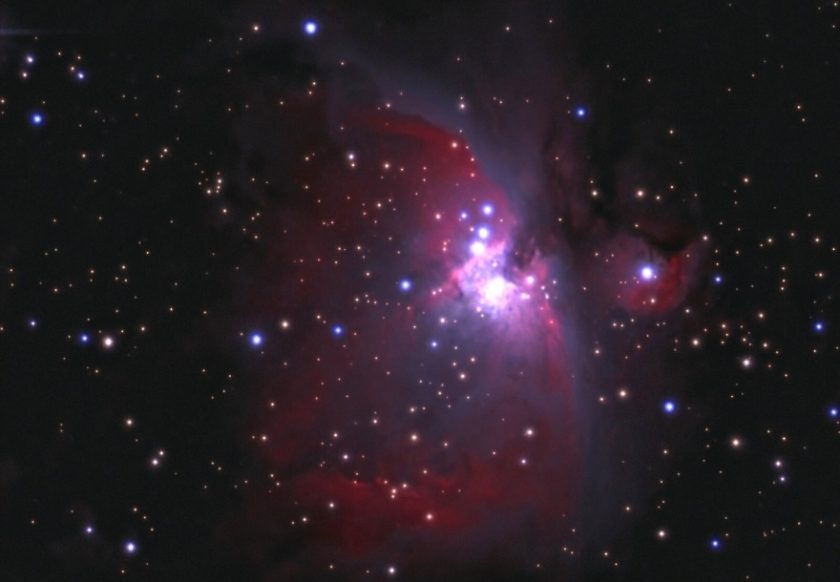
The Orion Nebula is a huge cloud of gas and dust where new stars are being born. It is located about 1,300 light-years away in the constellation Orion. At the centre of the nebula is a bright group of young stars called the Trapezium Cluster. These stars are very hot and powerful, and their energy makes the surrounding gas glow in beautiful colours.
Astronomers study the Orion Nebula because it is one of the closest places where stars are forming. Inside the cloud, gravity slowly pulls gas and dust together until new stars are created. Some of these young stars are surrounded by disks of dust where planets might eventually form. Because it is relatively close to Earth, the Orion Nebula is one of the easiest and most impressive deep-sky objects to observe with binoculars or a small telescope. Next time you spot the constellation Orion, look just below Orion’s Belt – the ‘sword’ hanging beneath it contains the nebula.
Seeing Saturn
Visually speaking, Saturn is probably the most distinct planet so I was excited to see it with my own eyes complete with its iconic ring. Saturn has over 149 moons. The largest, Titan, is even bigger than the planet Mercury and has lakes and rivers made of liquid methane.
Fun fact: although Saturn takes about 29 Earth years to orbit the Sun, it spins very quickly. One day on Saturn lasts only about 10½ hours.
If you’re heading to the Atacama desert, a stargazing tour should absolutely be at the top of your list of things to do. With the help of a deeply knowledgeable guide, the science in the sky will never feel more alive and accessible.
How to get to the Atacama Desert
The simplest way is to fly from the Santiago. However, if you have the time, I recommend the 3-day overland border crossing from Uyuni Salt Flats in Bolivia. It’s one of the greatest overland journeys you can do in the whole of South America. The various and dramatic landscapes are truly out of this world.