
Ollantaytambo is a small but wonderfully compact town located in Peru’s Sacred Valley, a region revered for its natural beauty and spiritual atmosphere.
The journey getting to Ollantaytambo through winding roads and endless mountain scenery builds anticipation that turns to delight when you finally arrive. It’s like taking that first spoonful of your favourite fruit crumble that’s been slowly baking away in the oven after the sweet aroma has filled the whole house. You can’t help but smile.
The town has everything you could wish for straight from your doorstep. I’m talking about mountain views, charming streets, fascinating history, cultural attractions and stunning architecture.
Adding to the reasons to visit Ollantaytambo is the food. I unexpectedly had the best meal of my whole trip to Peru in town. My only regret is that I didn’t order more.
How long should you stay in Ollantaytambo?
While you can see most of the town’s highlights in a day, Ollantaytambo deserves more time to absorb the special atmosphere, wider attractions and foodie delights.
At a minimum I would recommend staying at least one night. If you enjoy hiking or wish to relax somewhere quieter than bigger cities like Lima or Cusco, opting for two or three nights allows you more time to relax and explore more places within the Sacred Valley.
Many travellers treat Ollantaytambo as a transit stop on the way to Machu Picchu, but it’s much more than just a brief pitstop. This is one of the few places in Peru where the Inca blueprint never fully disappeared. The streets still follow their original layout, water still runs through hand-cut channels, and the mountains press so close they feel like sentries rather than scenery.

A brief history of Ollantaytambo
Ollantaytambo was both a royal estate and a military stronghold, most famously associated with the Inca ruler Pachacuti in the 15th century. Its massive terraces and ceremonial buildings were engineered not only for agriculture but for defense, designed to control access to the valley below.
When the Spanish arrived, Ollantaytambo became the site of one of the Incas’ rare victories during Manco Inca’s rebellion in 1536. Spanish forces were pushed back using the terrain, flooding the plains and attacking from above. Eventually, the town succumbed to the conquestidors, but moreso than many Inca sites, it never emptied.
Ollantaytambo’s population is predominantly indigenous Quechua, descendants of the Incas, who maintain traditional Andean lifestyles and many of whom wear traditional clothing that brings so much colour and cultural identity to the region. They speak Quechua as their first language, but Spanish is also commonly spoken. In hotels and restaurants some English is spoken but not guaranteed.
Best things to do in in Ollantaytambo
Climb the Temple of the Sun archaeological site

The Temple of the Sun dwarfs the small town. The scale is both immediate and inspiring: enormous stones fitted together with surgical precision, some weighing over 50 tonnes.
It’s baffling how these stones were cut from the Kachiqata quarries on the far side of the Urubamba Valley, then dragged across the river and hauled up the mountainside without iron tools, wheels, or draft animals.
Climbing to the top requires a few stops to catch your breath in high altitude but the views and the feel of history are worth it. You are rewarded with a panorama over the Urubamba River, mountain scenery and the town’s perfect grid below.
From this height, you can understand how Ollantaytambo was one of the last significant strongholds and a crucial resistance point for the Incas during the Spanish conquest.
Look closely, and you will notice how several stones lie abandoned on the terraces and at the top. Frozen mid-journey, likely left there when the Spanish advance forced the Incas to retreat. You can see where work stopped – half-shaped stones, incomplete walls – which turns the site into a rare archaeological snapshot of a civilisation interrupted rather than eroded over centuries.
Do the short hike to the Pinkuylluna granaries

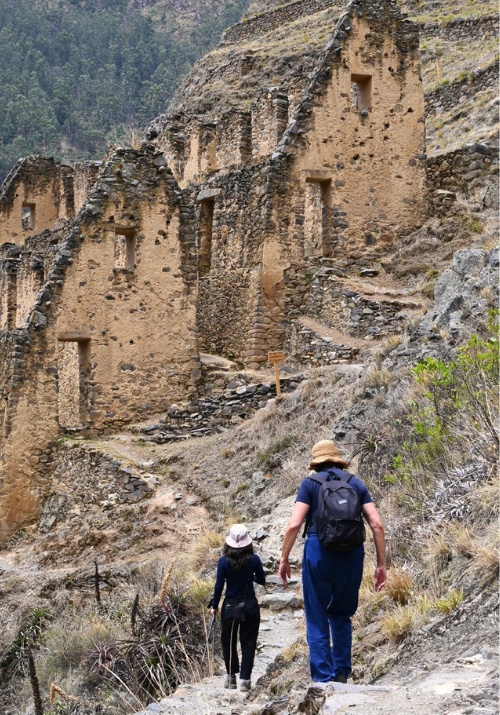
When you’re at the Temple of the Sun, one of the town’s most intriguing landmarks – the granaries – sit perched on the opposite hillside. As soon as I spotted them I knew I wanted to visit them up-close.
These constructions are rarely crowded and arguably offer the best view of the Ollantaytambo with the Temple of the Sun. The short but steep climb takes around 30 minutes and the entrance to the stairs is located directly opposite Kamma Hotel. For a truly unforgettable view, time your arrival with sunset.
Explore the old town
When I first arrived in Ollantaytambo, I was instantly taken by the charm of the old town. It’s super cute and pretty, in a way that I wondered why there were not more tourists. (I’m sure travelling out of season also made a big difference).
In any other country, a photogenic place like this would be swarming with tourists, but I found Ollantaytambo wonderfully peaceful. Even the cats and dogs seemingly live in harmony!

One of the best things to do in Ollantayambo is simply to wander around the town’s narrow cobbled lanes without a plan. You can enjoy original Inca foundations, and water channels still doing the job they were designed to do. Day trippers usually spend most of their time at the Temple of the Sun and the main plaza, while the rest of town offer quiet slices of local life.
Enjoy delicious Peruvian food in a beautiful garden

Strangely, Alqa Restaurant rarely appears on a search of restaurants in Ollantaytambo. My travel companions and I had already eaten very well at numerous places in town under the direction of Google reviews, but during my search Alqa had not appeared.
Instead, I stumbled across this place while walking to the trailhead of the Pinkuylluna granaries. I peered my head through a little courtyard and a waiter inside told me it was a restaurant. Intrigued, I said we would return a bit later.
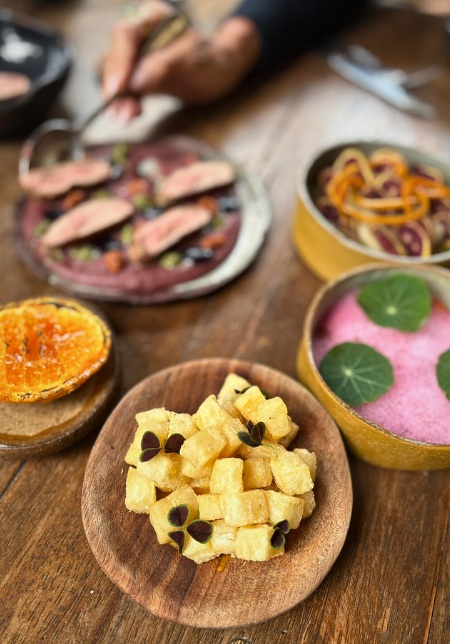
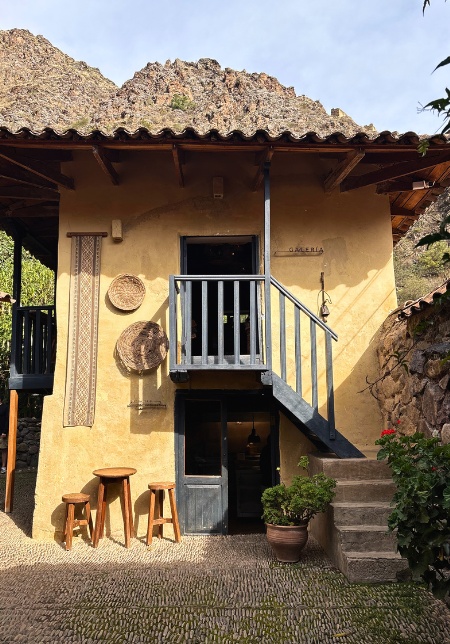
True to word, and well-deserved after working up an appetite, we entered the courtyard and the same waiter took us through to an oasis-like garden furnished with beautiful wooden seating that looked like something out of Architectural Digest magazine. We were the only people there, adding to the feeling that we had stumbled across a hidden gem. If the food tasted as good as the setting looked – I knew we would be in for a treat.
Each dish was creative, modern, tasty and distinctively Peruvian. Adding to the overall experience was the setting enclosed within a beautiful walled garden surrounded by fruit trees, herbs, flowers and humming birds. The epitimony of relaxation.
Even if you’re not hungry, I still encourage you to pop in to enjoy a refreshing drink and soak up the serene atmosphere.
Enjoy a scenic hike to the Pumamarca ruins
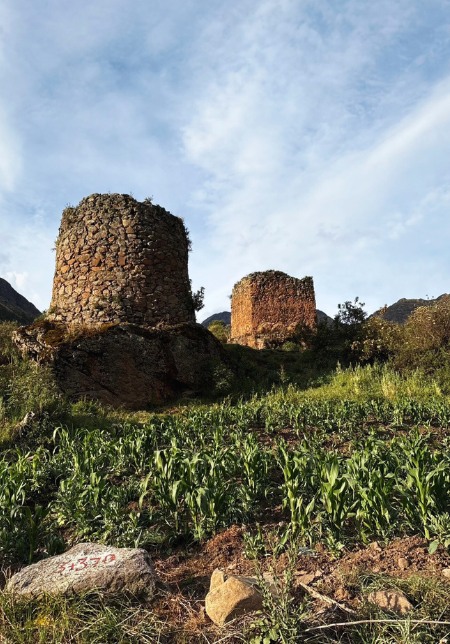
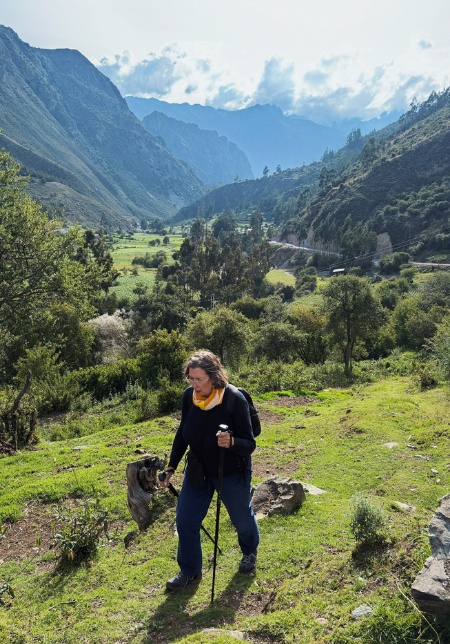
A longer but excellent day hike, Pumamarca takes you into quieter, rural highlands above Ollantaytambo. The trail winds through farming communities, open grassland, and eventually reaches the Pumamarca archaeological site, a cluster of terraces and stone buildings perched high above the valley.
To manage your expectations, the archaeological site itself is not comparable to the likes of Temple of the Sun or Machu Picchu. Instead, the beautiful vistas that bless you along the way are the real prize.
A round trip will take you about 4-5.5 hours depending on your speed and how often you stop for photos and breaks. Alternatively, you can take a taxi as close to the ruins as possible, and do the return route by foot. We wanted to do this but the road to the ruins was undergoing construction so we ended up doing the longer route.
You’re unlikely to see many other hikers, and that isolation is part of the appeal. It’s not technical, but ensure to wear sturdy footwear and bring plenty of water. For a more detailed account, I recommend reading this guide to hiking the Pumamarca ruins.
Visit the dazzling Salt Mines of Maras

Just a 25-minute drive from Ollantaytambo is the ancient salt mines of Maras, one of the most unique attractions of the Sacred Valley. Thousands of shallow white pools etch across a mountainside and shimmer brightly under the sun.
After all the archeological ruins, these salt mines provided a surprising and welcomed break. It’s incredible to think that the production of salt at Maras has been in continuation since pre-Inca times.
Each pool belongs to a local family, passed down through generations. During the dry season (October to April), water is diverted into the pans, where it slowly evaporates under the Andean sun, leaving behind crystalline salt that is then scraped, dried, and bagged.
Every month, 125kg of salt is harvested from each pool – and there are over 3500 pools – so that’s a whole lotta salt! Little has changed. It remains the bread and butter of the local economy. The main difference is that the salt is now distributed world-wide and this place has now become a tourist attraction too!
See Moray archeological site

Combine a visit to the Maras salt mines with the Moray ruins as they are less than 30-minutes apart by car. The Moray ruins are one of the Sacred Valley’s most intriguing sites. The archaeological site comprises of three concentric circles that look straight out of a Sci-Fi film. The lack of information about them also adds to their mysteriousness.
Moray is generally believed to have been constructed during the late Inca period, around the 15th century. There is no written record – the Inca left no conventional written language – so dating relies on archaeological analysis of construction style, terrace engineering, and comparison with other confirmed Inca sites.
What’s clear is that Moray was already abandoned by the time the Spanish arrived. Archaeological excavations show no signs of late-period occupation, and it wasn’t mentioned in early colonial chronicles or administrative documents, unlike places such as Ollantaytambo or Pisac. So while it might have been overlooked and forgotten about, I’m glad this isn’t the case now.
Use Ollantaytambo as a base, not a stop
Ollantaytambo works fabulously as a base for exploring the Sacred Valley. The train to Machu Picchu also departs from Ollantaytambo so you could opt to stay the night before as opposed to popping in just for the afternoon.
Many people visiting Machu Picchu opt to stay in the nearest town which is Aguas Calientes. I stayed in both places and prefered Ollantaytambo by a considerable amount. It’s a lot more charming and authentic, whereas Aguas Clientas has been built purely for tourism. Thankfully, the mountain setting is nice so it does have that going for it.
Where to stay depends on whether you plan to visit Machu Picchu in the morning or afternoon. If you plan to visit Machu Picchu in the afternoon, Ollantaytambo is the better choice, but if you have a very early ticket then staying in Aguas Calientes would be advantageous.
However, trains from Ollantaytambo to Aguas Calientes take around 1h 30 m and start as early as 5am (and sometimes earlier) so you could still stay in Ollantaytambo the night before for the early ticket to Machu Picchu.
Anyhow, hopefully I have convinced you to include Ollantaytambo into your Peru itinerary. It’s not just a charming place to explore, but a practical one too. It’s well-located for visiting many other attractions in the beautiful Sacred Valley – Maras Salt Mines, Moray, Chinchero, Pisac – and even Machu Picchu.